
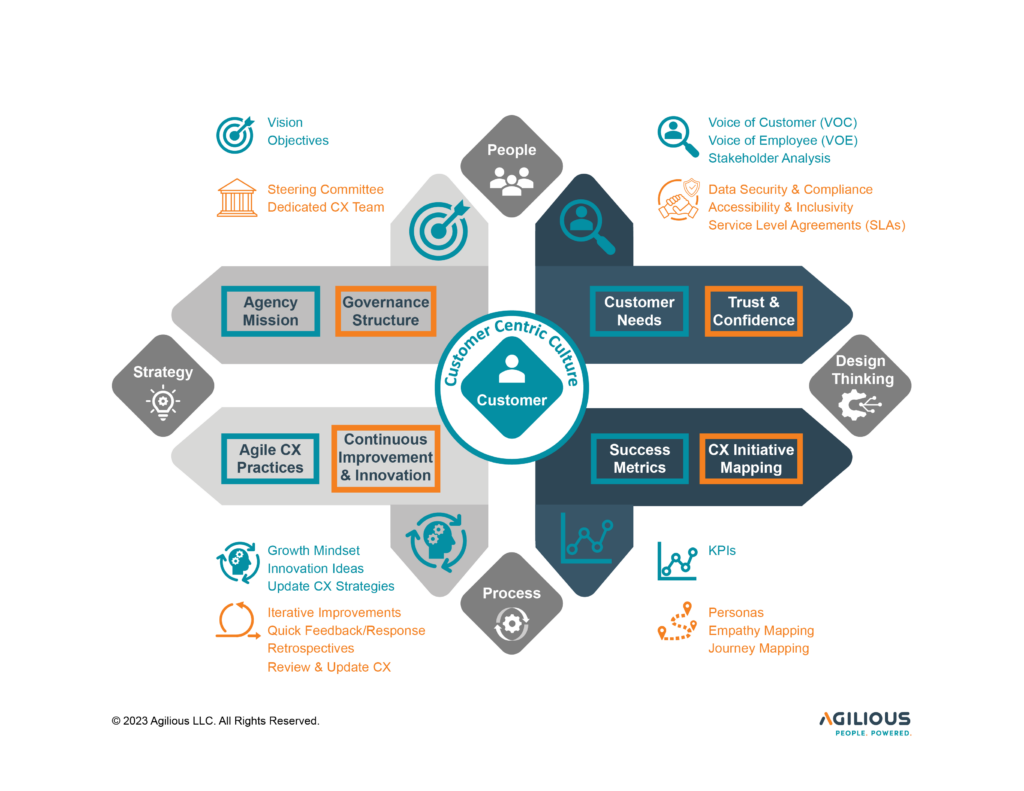
Agilious’ Customer Experience (CX) framework uses a systematic approach that is tailored to the unique characteristics of Government operations. This comprehensive framework helps create a CX strategy that is aligned with the agency’s mission, establishing a CX governance structure, improving engagement with the customer to understand their needs and build trust, being compliant with regulations, establishing clear CX metrics, and implementing agile CX practices.

Strategy
Having a comprehensive Customer Experience (CX) strategy is essential to align with the agency’s overall vision and objectives. The CX objectives are achieved with an effective governance structure.

Agency Mission
At the core of our CX strategy is a meticulous analysis of the agency’s mission, ensuring that every interaction aligns with the overarching goals of the public service that the agency provides.

Governance Structure
The governance structure is designed to uphold transparency, accountability, and responsiveness. This is achieved through the establishment of cross-functional teams to oversee CX initiatives, drawing expertise from various domains to ensure a holistic and inclusive approach. By intertwining the agency mission with a robust governance structure, the CX strategy elevates the user experience for the American public interacting with federal digital services.

People
Customer Needs
Public users and federal employees are central to our CX framework. It prioritizes the American people’s experience by cultivating a user-centric mindset, understanding their needs, and implementing user-friendly interfaces across all touchpoints. This entails deploying simple, intuitive digital solutions, enhancing accessibility, and ensuring multichannel communication to cater to diverse demographics.
Simultaneously, recognizing the federal employee as a vital player in this ecosystem is crucial. Our CX framework requires investing in training programs, fostering a culture of empathy, and providing the necessary tools and resources so that federal employees are empowered to deliver a seamless experience. By nurturing a symbiotic relationship between the American people and federal employees, it enhances the overall satisfaction, efficiency, and effectiveness of federal digital services.

Voice of the Customer (VOC)
Voice of the Customer (VOC) refers to the valuable insights and feedback obtained directly from customers, offering a firsthand understanding of their expectations, preferences, and experiences with a product or service. We leverage the Voice of Customer (VOC) as an instrument in enhancing the experience for American people.

Trust & Confidence
To build trust and confidence of the American people in federal digital services, our CX framework prioritizes accessibility to ensure that services are available to all, regardless of physical abilities, language proficiency, or technological literacy. This inclusivity reinforces the notion that federal services are designed to serve everyone.

Design Thinking
Design thinking tools and technologies play a crucial role in our CX framework. They provide a structured approach to understanding, ideating, and implementing solutions, ensuring that customer experiences are not only user-centric, but also continuously refined and improved based on real insights and feedback.

CX Initiative Mapping
Below are some tools and technologies that we use to enhance the design thinking process for CX.
User Personas and Empathy Mapping
Create detailed user personas and empathy maps to better understand and empathize with the target audience, helping to tailor services to their specific needs.
Customer Journey Mapping
Visualize and analyze the customer journey to identify pain points and opportunities for improvement in the overall experience.
Prototyping and Wireframing
Rapidly prototype and iterate on design concepts, allowing for quick visualization and validation of potential solutions.
Usability Testing
Conduct remote or in-person usability tests with real end users to gather feedback on the usability and effectiveness of CX designs.
Accessibility Testing
Ensures designs and digital interfaces adhere to accessibility standards (like 508 and WCAG), making them inclusive for users with diverse needs.

Success Metrics
CX success metrics for the federal government must align with the unique goals and responsibility of the federal agency. While some metrics are similar to those in the private sector, there are specific considerations for the public sector. Below are some success metrics that our CX framework recommends.
Citizen Satisfaction Index (CSI)
Similar to Customer Satisfaction (CSAT), CSI measures the American public’s satisfaction with Government services. It is measured as a percentage of satisfied American public users based on survey responses.
Trust In Government
Measures the American public’s trust in Government agencies and their ability to fulfill their missions. It is measured as a percentage of the American public expressing trust in the government based on surveys.
Accessibility and Inclusivity
Evaluates the accessibility and inclusivity of government services for diverse populations, including people with disabilities and those with limited English proficiency. It is measured by its compliance with accessibility standards and feedback from marginalized communities.
Data Privacy and Security
Evaluates the American public’s trust in the government’s ability to protect their data and ensure privacy. It is measured by its compliance with data protection regulations and incidents of data breaches.
Federal Employee Satisfaction
Satisfied and engaged federal employees are more likely to provide better service, impacting overall satisfaction of the American people. It is measured using employee satisfaction surveys, retention rates, and feedback.

Process
Our CX framework seamlessly integrates agile processes to enhance our responsiveness to the evolving needs of the American people. It prioritizes collaboration, flexibility, and iterative development. By applying Agile CX practices, and Continuous Improvement & Innovation, we can stay aligned with the ever-changing preferences and experiences of the American people.

Agile CX Practices
Agile CX practices are an integral part of our CX framework that enable us to collaborate with the customer throughout the iterative discovery and development process.
Through the implementation of Agile frameworks such as Scrum or Kanban, we break down the work into manageable sprints, allowing for incremental improvements and adjustments based on ongoing feedback. This iterative process not only ensures that customer preferences and expectations are continually met, but also fosters a culture of adaptability within the federal agency.

Continuous Improvement & Innovation
Continuous improvement and innovation are essential components of our CX framework. By consistently seeking ways to enhance processes, refine services, and address pain points identified through end user and customer feedback, we stay ahead of the curve in an ever-changing landscape. We implement regular retrospectives to enable product development teams to identify areas for improvement and celebrate successes, fostering a culture of continuous learning and innovation.
In essence, the synergy of Agile CX practices and a commitment to continuous improvement helps to deliver a customer experience that not only meets, but exceeds expectations in an increasingly dynamic environment.